Fifty Governments Stand Firm on the Drive for Economic Resilience

Rotterdam, the Netherlands, April 16, 2025 (GLOBE NEWSWIRE) — The Global Center on Adaptation (GCA) today hosted an inaugural Ambassadors’ Forum galvanizing global support for accelerating adaptation at speed and at scale. The event, hosted at the GCA’s Rotterdam Headquarters, called on governments, industries and civil society to redouble efforts to build “resilient economies” as the growth engine for the 21st century.

Ambassadors and senior diplomatic representatives from 50 nations gathered in a show of support and unity for the adaptation and resilience agenda. Delegates committed to spurring sustainable growth, fostering new industries, driving innovation, and unlocking private finance to ease mounting pressures on development aid and public climate finance. The global market for climate adaptation solutions—such as advanced weather analytics, parametric insurance, and water-efficient infrastructure— is projected to be worth USD 2 trillion annually by 2026.

Welcoming the attendees, Professor Patrick V. Verkooijen, President & CEO of the Global Center on Adaptation, lauded the diplomatic community for recognizing that adaptation is not merely a defensive measure but an essential component of global economic strategy: “We are already in the ‘Resilience Endgame’. We must prepare today for the 1.5-degree world. The devastating global impacts we see today need not define the society of tomorrow. The escape plan is to double down on adaptation and capture its incredible economic dividends.” He added that “the Africa Adaptation Acceleration Program, our flagship initiative, the largest adaptation program in the world, has shown us that growth and building resilience are intrinsically linked. But we can do so much more – together. Adaptation is about future-proofing our economies, protecting critical infrastructure, safeguarding food supplies, and ensuring that new opportunities can thrive in changing conditions. By rallying together, we multiply the impact of innovative investments and encourage the ‘resilience dividend’—the powerful, compounding benefits that flow from forward-thinking action.”

Delivering remarks, Professor Jan Peter Balkenende, Former Prime Minister of the Netherlands, Minister of State, and Executive Board Member of the GCA, emphasized that genuine progress on climate resilience will unlock broad-based dividends: “What happens in the most vulnerable countries does not stay there. Climate change amplifies food insecurity, migration, and conflict. In fragile states, environmental stress can become a security threat. Europe and the world must take this seriously. Investing in resilience is not only right — it is wise.” He added that “This is why we need true global cooperation, based on shared interest and shared responsibility.”

Reflecting on adaptation efforts in Africa and beyond, H.E. Halima Mucheke, Ambassador of the Republic of Kenya in the Kingdom of the Netherlands, spoke about the significance of GCA’s new headquarters in Nairobi: “Kenya is proud to host the GCA’s new headquarters in Nairobi which will intensify support for adaptation programs across Africa, leading these programs North-South. Around the world, resilient infrastructure is the hot new investment class. Climate adaptation is a framework for protecting infrastructure, securing food systems and creating new business and job opportunities. And it is being aided by a thriving market in climate solutions.” He added that “The continent’s leading initiative in this area – the Africa Adaptation Acceleration Programme (AAAP) – has already channelled more than $15bn to strengthen essential systems against climate shocks. These funds are helping to secure the adaptability and livelihoods of nearly 60 million vulnerable people in 40 countries. We need to keep scaling this up, working as a global community, North-South, South-South, South-North–all together.”

Following the opening remarks delegates also heard from the lead architect and founder of Powerhouse Company, Nanne de Ru, about how GCA’s European headquarters at the Floating Office Rotterdam is an award-winning sustainable building recognized worldwide as a model for climate-resilient infrastructure.
The reception forms part of GCA’s broader advocacy strategy to advance climate adaptation solutions worldwide—focusing on protecting infrastructure, securing food systems, catalysing economic growth, and fostering global collaboration. By bringing together high-level diplomats, GCA reinforced its role as a leading international organisation in developing and implementing adaptation strategies that bolster economies against intensifying climate shocks.

Participating Countries and Representatives
A wide cross-section of the diplomatic community participated in the reception:


  1. Afghanistan: H.E. Mr. Mohammad Asif Rahimi (Ambassador)
  2. Algeria: Ms. Ghalia Benziouche (Minister Counselor)
  3. Australia: H.E. Dr. Greg French (Ambassador), Ms. Milena Arsic (First Secretary), Mr. Sybren Holt (Research Officer in Charge of Investment and Trade)
  4. Austria: Mr. Oliver Crazzolara (Ambassador’s Assistant – Policy & Research Officer)
  5. Azerbaijan: H.E. Mr. Mammad Ahmadzada (Ambassador)
  6. Barbados: H.E. N. Simone Rudder (Ambassador)
  7. Belarus: H.E. Andrei Yeudachenka (Ambassador)
  8. Bolivia: H.E. Roberto Calzadilla Sarmiento (Ambassador)
  9. Brazil: Mr. Gaétan Spielmann Moura (Secretary)
  10. Burkina Faso: H.E. Mr. Léopold Tonguenoma Bonkoungou (Ambassador)
  11. Burundi: H.E. Ms. Isabelle Ndahayo (Ambassador)
  12. Cameroon: H.E. Mrs. Liguemoh Ondoua Madeleine (Ambassador)
  13. Chile: H.E. Jorge Carvajal (Ambassador), Mrs. María Fernanda Vila (Minister Counselor)
  14. China: Mr. Gu Yanbin (Second Secretary), Ms. Zhan Leilei (Second Secretary)
  15. Comoros: H.E. Mohamed Chatur Badaoui (Ambassador)
  16. Costa Rica: H.E. Arnoldo Brenes Castro (Ambassador)
  17. Croatia: H.E. Dubravka Plejić Marković (Ambassador)
  18. Cuba: H.E. Mrs. Eva Yelina Silva Walker (Ambassador)
  19. Czech Republic: Mr. Stanislav Beneš (Minister Counsellor)
  20. Denmark: Ms. Anniek Barnhoorn (Academic Officer)
  21. El Salvador: H.E. Agustín Vásquez Gómez (Ambassador)
  22. Ethiopia: H.E. Ambassador Eshete Tilahun (Ambassador)
  23. Ghana: H.E. Francis Kotia (Ambassador)
  24. Greece: Ms. Antigoni Bampi (Scientific Collaborator)
  25. Guatemala: H.E. Mrs. Ana Cristina Rodríguez Pineda (Ambassador)
  26. Hungary: Mr. Dániel Csonka (Deputy Head of Mission)
  27. India: H.E. Mr. Kumar Tuhin (Ambassador)
  28. Kenya: H.E. Halima Mucheke (Ambassador)
  29. Lithuania: H.E. Neilas Tankevičius (Ambassador)
  30. Malaysia: H.E. Roseli Abdul (Ambassador)
  31. Malta: Mr. Matthew Grima (Deputy Head of Mission)
  32. Montenegro: Mr. Milisav Raspopović (Charge d’Affaires)
  33. Morocco: H.E. Mr. Mohamed Basri (Ambassador)
  34. Nepal: H.E. Sewa Lamsal (Ambassador)
  35. Nigeria: Mrs. Nnenne E. Ibekaku (Charge d’Affaires)
  36. Pakistan: H.E. Ambassador Syed Haider (Ambassador)
  37. Panama: H.E. Mrs. Sally LOO HUI (Ambassador)
  38. Peru: Mr. Carlos Díaz (International Cooperation and Cultural Attaché)
  39. Philippines: H.E. J. Eduardo Malaya (Ambassador)
  40. Qatar: Mr. Saad Yousif Saad Al-Mana (First Secretary)
  41. Rwanda: Mr. Jean Hugues Mukama (Charge d’Affaires)
  42. Saudi Arabia: H.H. Prince Jalawi Al Saud (Ambassador)
  43. Senegal: H.E. Madame Ramatoulaye Ba Faye (Ambassador), Mr. Henry Pierre Sarr (First Secretary)
  44. Somalia: H.E. Khadija O. Ali (Ambassador)
  45. South Africa: H.E. Mr. Vusimuzi Philemon Madonsela (Ambassador)
  46. Türkiye: Mr. Bilal Köse (Consul)
  47. Yemen: H.E. Sahar Ghanem (Ambassador)


Notes to Editors
About the Global Center on Adaptation
The Global Center on Adaptation (GCA) is an international organization that promotes adaptation to the impacts of climate change. It works to climate-proof development by instigating policy reforms and influencing investments made by international financial institutions and the private sector. The goal is to bring climate adaptation to the forefront of the global fight against climate change and ensure that it remains prominent.

Founded in 2018, GCA embodies innovation in its approach to climate adaptation as well as in its physical presence. It operates from the largest floating office in the world, in Rotterdam, the Netherlands. GCA has a worldwide network of regional offices in Abidjan, Côte d’Ivoire; Dhaka, Bangladesh; and Beijing, China. The Center will open a new office in Nairobi, Kenya in 2025.

Alexandra Gee
Global Center on Adaptation
+447887804594
[email protected]

GlobeNewswire Distribution ID 9423490
Sabin Begins Marburg Vaccine Trial in U.S.

Sabin Begins Marburg Vaccine Clinical Trial in U.S.
Sabin begins a multi-site Phase 2 clinical trial of its Marburg vaccine candidate in U.S.

Sabin begins a multi-site Phase 2 clinical trial of its Marburg vaccine candidate in U.S.

WASHINGTON, April 16, 2025 (GLOBE NEWSWIRE) — The Sabin Vaccine Institute has launched a multi-site Phase 2 clinical trial in the U.S. for its Marburg vaccine candidate, administering doses to the first participants in Melbourne, Florida. This trial builds on ongoing Phase 2 testing in Kenya and Uganda, with initial findings from that research expected in the coming months.

Sabin’s vaccine development efforts, including clinical trials, are becoming increasingly critical as Marburg outbreaks grow in frequency, underscoring the urgent need for vaccines to protect those at highest risk. Sabin supported an open-label Phase 2 clinical trial sponsored by the Rwanda Biomedical Centre (RBC) by supplying the investigational vaccine during Rwanda’s 2024 Marburg outbreak. More than 1,700 individuals — primarily frontline health care workers — were vaccinated, with first doses arriving within nine days of the outbreak being declared. Data from the RBC trial will be shared with Sabin to support the vaccine’s licensure.

Rwanda’s outbreak ended on December 20 with a case fatality rate of 23%, lower than the historical average of 50%. Fatality rates in outbreaks can vary due to multiple factors, including greater surveillance, prompt detection, supportive care, and the overall response effort. On January 20, Tanzania declared an outbreak of Marburg virus disease, which ended on March 13.

Currently, there are no approved vaccines for Marburg virus disease.

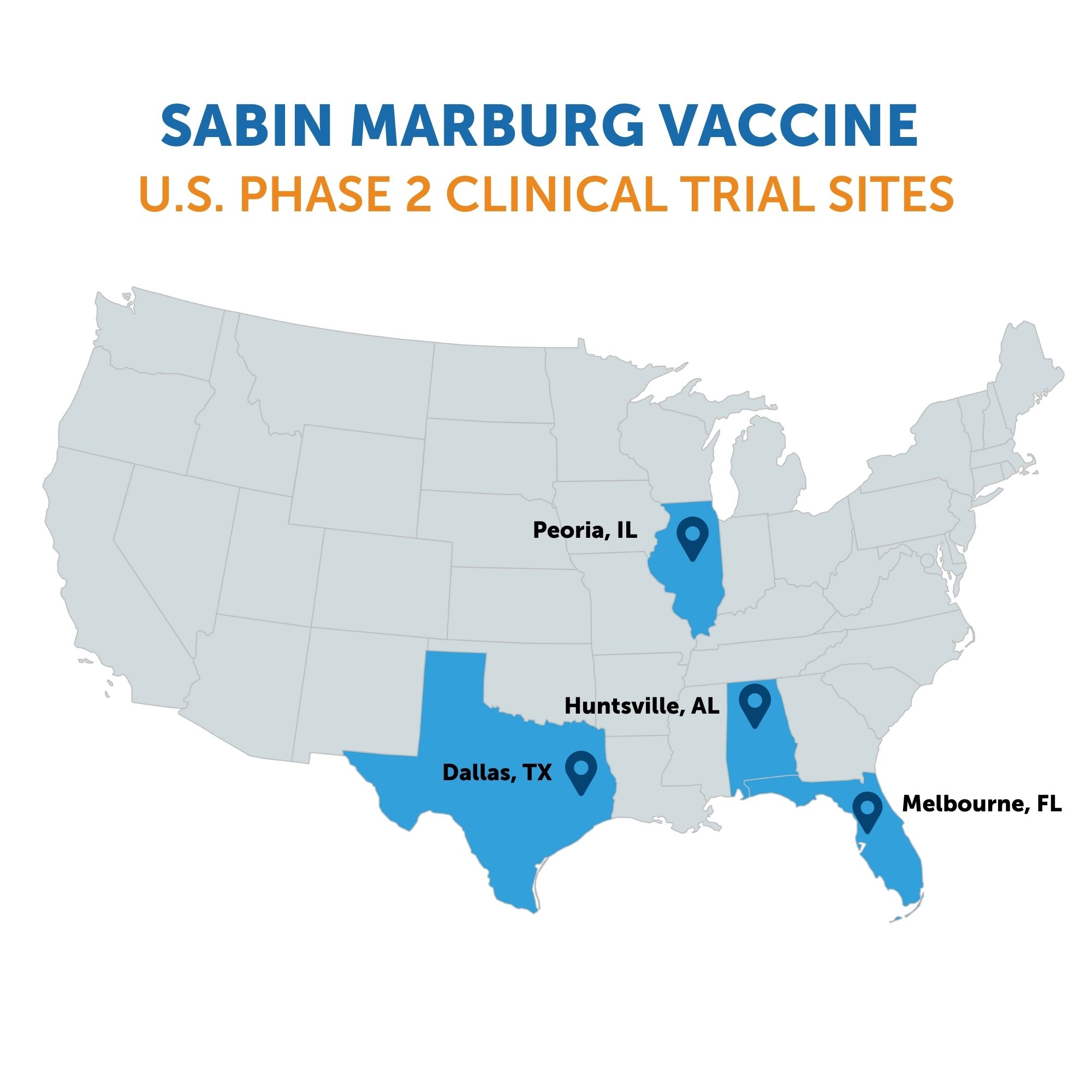
For the U.S. clinical trial that began this week, Sabin will recruit 200 volunteers aged 18 to 70 across four locations – in addition to Melbourne, the vaccine will be tested at sites in Dallas, Texas; Huntsville, Alabama; and Peoria, Illinois. The randomized, placebo-controlled, double-blind trial will continue to evaluate safety and immunogenicity, and will monitor vaccinated volunteers for a year.

“Recent outbreaks highlight the urgent need to strengthen our defenses against this deadly and unforgiving disease,” says Amy Finan, Sabin’s Chief Executive Officer. “Sabin’s Phase 2 clinical trials will generate essential data to move this vaccine closer to licensure — and offer a potentially life-saving tool where none exists.”

Marburg is a filovirus, in the same family as the virus that causes Ebola. Like Ebola, Marburg virus disease spreads via direct contact with the blood or other bodily fluids of infected individuals. It is highly virulent and causes hemorrhagic fever.

“Conducting clinical trials in Africa is key to evaluating the vaccine in regions where Marburg and other filoviruses are most common or endemic,” notes Kelly Warfield, Sabin’s President of Research & Development. “The U.S. trial will give us vital safety and immune response data for non-endemic populations, helping us better prepare for outbreaks and spread of this disease.”

Based on the cAd3 platform, Sabin’s single-dose investigational Marburg vaccine was found to be promising in Phase 1 clinical and non-clinical studies, with results showing it to be safe, while eliciting rapid and robust immune responses.

The Marburg vaccine trials are supported by the Biomedical Advanced Research and Development Authority (BARDA), part of the Administration for Strategic Preparedness and Response within the U.S. Department of Health and Human Services, under multi-year contracts between the organizations.

BARDA and Sabin began working together in September 2019 to develop monovalent vaccine candidates for Marburg virus and Sudan virus diseases. To date, Sabin has received around $252 million in contract awards from BARDA for furthering vaccine research and development against these two disease threats.

A Phase 2 clinical trial for Sabin’s Sudan virus vaccine is underway in Uganda and Kenya. The cAd3 Sudan vaccine candidate will also be tested among adult volunteers in the U.S. later this year.

This project has been supported in whole or in part with federal funds from the Department of Health and Human Services; Administration for Strategic Preparedness and Response; Center for the Biomedical Advanced Research and Development Authority (BARDA), under contract numbers 75A50119C00055 and 75A50123C00010.

For information about Sabin’s Phase 2 Marburg vaccine trials, visit:
Clinicaltrials.gov — NCT06620003 (U.S. trial)
Clinical.trials.gov — NCT05817422 (Uganda and Kenya trial)
Pan African Clinical Trials Registry — PACTR202306534727467 (Uganda and Kenya trial)

About the Sabin Vaccine Institute

The Sabin Vaccine Institute is a leading advocate for expanding vaccine access and uptake globally, advancing vaccine research and development, and amplifying vaccine knowledge and innovation. Unlocking the potential of vaccines through partnership, Sabin has built a robust ecosystem of funders, innovators, implementers, practitioners, policy makers and public stakeholders to advance its vision of a future free from preventable diseases. As a non-profit with three decades of experience, Sabin is committed to finding solutions that last and extending the full benefits of vaccines to all people, regardless of who they are or where they live. At Sabin, we believe in the power of vaccines to change the world. For more information, visit www.sabin.org and follow us on X @SabinVaccine.

About Sabin’s Vaccine R&D and the cAd3 Platform

In August 2019, Sabin announced exclusive agreements with GSK for Sabin to advance the development of the prophylactic candidate vaccines against the deadly Zaire ebolavirusSudan virus, and Marburg virus. The three candidate vaccines were initially developed collaboratively by the U.S. National Institutes of Health and Okairos, which was acquired by GSK in 2013. The candidate vaccines, based on GSK’s proprietary cAd3 (Chimpanzee Adenovirus Type 3) platform, were further developed by GSK, including the Phase 2 development for the Zaire ebolavirus vaccine. Under the agreements between GSK and Sabin, Sabin exclusively licensed the technology for all three candidate vaccines and acquired certain patent rights specific to these vaccines.

Media Contact:
Monika Guttman
Senior Media Relations Specialist
Sabin Vaccine Institute
+1 (202) 621-1691
[email protected]

A photo accompanying this announcement is available at https://www.globenewswire.com/NewsRoom/AttachmentNg/cdb8a6cd-2ff2-49bd-aeb4-43e859c1b44f

GlobeNewswire Distribution ID 9423434

Sabin Begins Marburg Vaccine Trial in U.S.

Sabin Begins Marburg Vaccine Clinical Trial in U.S.
Sabin begins a multi-site Phase 2 clinical trial of its Marburg vaccine candidate in U.S.

Sabin begins a multi-site Phase 2 clinical trial of its Marburg vaccine candidate in U.S.

WASHINGTON, April 16, 2025 (GLOBE NEWSWIRE) — The Sabin Vaccine Institute has launched a multi-site Phase 2 clinical trial in the U.S. for its Marburg vaccine candidate, administering doses to the first participants in Melbourne, Florida. This trial builds on ongoing Phase 2 testing in Kenya and Uganda, with initial findings from that research expected in the coming months.

Sabin’s vaccine development efforts, including clinical trials, are becoming increasingly critical as Marburg outbreaks grow in frequency, underscoring the urgent need for vaccines to protect those at highest risk. Sabin supported an open-label Phase 2 clinical trial sponsored by the Rwanda Biomedical Centre (RBC) by supplying the investigational vaccine during Rwanda’s 2024 Marburg outbreak. More than 1,700 individuals — primarily frontline health care workers — were vaccinated, with first doses arriving within nine days of the outbreak being declared. Data from the RBC trial will be shared with Sabin to support the vaccine’s licensure.

Rwanda’s outbreak ended on December 20 with a case fatality rate of 23%, lower than the historical average of 50%. Fatality rates in outbreaks can vary due to multiple factors, including greater surveillance, prompt detection, supportive care, and the overall response effort. On January 20, Tanzania declared an outbreak of Marburg virus disease, which ended on March 13.

Currently, there are no approved vaccines for Marburg virus disease.

For the U.S. clinical trial that began this week, Sabin will recruit 200 volunteers aged 18 to 70 across four locations – in addition to Melbourne, the vaccine will be tested at sites in Dallas, Texas; Huntsville, Alabama; and Peoria, Illinois. The randomized, placebo-controlled, double-blind trial will continue to evaluate safety and immunogenicity, and will monitor vaccinated volunteers for a year.

“Recent outbreaks highlight the urgent need to strengthen our defenses against this deadly and unforgiving disease,” says Amy Finan, Sabin’s Chief Executive Officer. “Sabin’s Phase 2 clinical trials will generate essential data to move this vaccine closer to licensure — and offer a potentially life-saving tool where none exists.”

Marburg is a filovirus, in the same family as the virus that causes Ebola. Like Ebola, Marburg virus disease spreads via direct contact with the blood or other bodily fluids of infected individuals. It is highly virulent and causes hemorrhagic fever.

“Conducting clinical trials in Africa is key to evaluating the vaccine in regions where Marburg and other filoviruses are most common or endemic,” notes Kelly Warfield, Sabin’s President of Research & Development. “The U.S. trial will give us vital safety and immune response data for non-endemic populations, helping us better prepare for outbreaks and spread of this disease.”

Based on the cAd3 platform, Sabin’s single-dose investigational Marburg vaccine was found to be promising in Phase 1 clinical and non-clinical studies, with results showing it to be safe, while eliciting rapid and robust immune responses.

The Marburg vaccine trials are supported by the Biomedical Advanced Research and Development Authority (BARDA), part of the Administration for Strategic Preparedness and Response within the U.S. Department of Health and Human Services, under multi-year contracts between the organizations.

BARDA and Sabin began working together in September 2019 to develop monovalent vaccine candidates for Marburg virus and Sudan virus diseases. To date, Sabin has received around $252 million in contract awards from BARDA for furthering vaccine research and development against these two disease threats.

A Phase 2 clinical trial for Sabin’s Sudan virus vaccine is underway in Uganda and Kenya. The cAd3 Sudan vaccine candidate will also be tested among adult volunteers in the U.S. later this year.

This project has been supported in whole or in part with federal funds from the Department of Health and Human Services; Administration for Strategic Preparedness and Response; Center for the Biomedical Advanced Research and Development Authority (BARDA), under contract numbers 75A50119C00055 and 75A50123C00010.

For information about Sabin’s Phase 2 Marburg vaccine trials, visit:
Clinicaltrials.gov — NCT06620003 (U.S. trial)
Clinical.trials.gov — NCT05817422 (Uganda and Kenya trial)
Pan African Clinical Trials Registry — PACTR202306534727467 (Uganda and Kenya trial)

About the Sabin Vaccine Institute

The Sabin Vaccine Institute is a leading advocate for expanding vaccine access and uptake globally, advancing vaccine research and development, and amplifying vaccine knowledge and innovation. Unlocking the potential of vaccines through partnership, Sabin has built a robust ecosystem of funders, innovators, implementers, practitioners, policy makers and public stakeholders to advance its vision of a future free from preventable diseases. As a non-profit with three decades of experience, Sabin is committed to finding solutions that last and extending the full benefits of vaccines to all people, regardless of who they are or where they live. At Sabin, we believe in the power of vaccines to change the world. For more information, visit www.sabin.org and follow us on X @SabinVaccine.

About Sabin’s Vaccine R&D and the cAd3 Platform

In August 2019, Sabin announced exclusive agreements with GSK for Sabin to advance the development of the prophylactic candidate vaccines against the deadly Zaire ebolavirusSudan virus, and Marburg virus. The three candidate vaccines were initially developed collaboratively by the U.S. National Institutes of Health and Okairos, which was acquired by GSK in 2013. The candidate vaccines, based on GSK’s proprietary cAd3 (Chimpanzee Adenovirus Type 3) platform, were further developed by GSK, including the Phase 2 development for the Zaire ebolavirus vaccine. Under the agreements between GSK and Sabin, Sabin exclusively licensed the technology for all three candidate vaccines and acquired certain patent rights specific to these vaccines.

Media Contact:
Monika Guttman
Senior Media Relations Specialist
Sabin Vaccine Institute
+1 (202) 621-1691
[email protected]

A photo accompanying this announcement is available at https://www.globenewswire.com/NewsRoom/AttachmentNg/cdb8a6cd-2ff2-49bd-aeb4-43e859c1b44f

GlobeNewswire Distribution ID 9423434

Clinton Health Access Initiative and OneSight EssilorLuxottica Foundation Launch Strategic Partnership to Expand Vision Care Access Across Africa

KIGALI, Rwanda, April 16, 2025 (GLOBE NEWSWIRE) — The Clinton Health Access Initiative (CHAI) and the OneSight EssilorLuxottica Foundation have announced a multi-year partnership to advance access to eyeglasses and build sustainable vision care systems across Africa. With a shared focus on health equity, the collaboration aims to address one of the continent’s most widespread yet neglected public health challenges: uncorrected poor vision.

In sub-Saharan Africa, an estimated 12.6 percent of the population lives with some form of refractive error, with 3.4 percent experiencing visual impairment due to uncorrected refractive error.¹ This silent barrier limits children’s ability to learn, adults’ ability to work, and older persons’ ability to live independently, often pushing entire families deeper into cycles of poverty. Yet, with access to a simple pair of eyeglasses, over 80 percent of vision impairments can be corrected or prevented.

Recognizing the wide-reaching impact of good vision, this partnership aims to expand equitable access to eye care across Africa through sustainable, system-level solutions. It will focus on:

  • Building local capacity to deliver refractive error services at scale.
  • Strengthening public health systems by establishing optical labs and training local teams.
  • Developing shared tools to track progress toward full coverage of refractive error care.

Through this partnership, the Foundation will support CHAI in significantly expanding access to affordable eyeglasses, accelerating the delivery of vision services across priority geographies. It will also provide technical expertise, equipment, and awareness resources to reach underserved communities.

In parallel, both organizations will work with government stakeholders to co-create implementation pathways and explore long-term integration into national health strategies.

“Poor vision holds people back from learning, working and living with dignity, especially children and older adults. CHAI’s ambition is to get glasses to over 50 million people in five years,” said Frederic Seghers, Senior Director for Assistive Technologies at CHAI. “Partnering with the OneSight EssilorLuxottica Foundation helps us move faster and reach farther toward that goal, thanks to their technical expertise and global presence.”

“Vision care has the power to unlock human potential, but too often, it remains out of reach for those who need it most,” said Mustapha Njie, Head of Africa, OneSight EssilorLuxottica Foundation. “This collaboration with CHAI allows us to build locally rooted, system-strengthening solutions that last. Their relationships with governments and commitment to inclusive development ensure that every clinic, lab, and pair of glasses contributes to a larger, sustainable shift in how vision care is delivered.”

Implementation begins in April 2025 across multiple countries in Africa, with an initial three-year period and the potential for expansion based on national priorities and programmatic success.

Media Contact:

Tamana Mulchand

[email protected]

About the OneSight EssilorLuxottica Foundation:

The OneSight EssilorLuxottica Foundation is a registered charitable organization dedicated to eliminating uncorrected poor vision within a generation. As part of EssilorLuxottica’s commitment to universal vision care, the Foundation works to expand access for millions in underserved communities worldwide. It is also the global collaborating partner of the World Health Organization’s SPECS 2030 initiative, which focuses on refractive error, myopia prevention, and improving access to vision care in low-resource settings.

Find out more at: onesight.essilorluxottica.com

About the Clinton Health Access Initiative:

The Clinton Health Access Initiative, Inc. (CHAI) is a global health organization committed to saving lives and improving health outcomes in low- and middle-income countries by enabling the government and private sector to strengthen and sustain quality health systems. For more information, please visit: www.clintonhealthaccess.org

¹ Source: PLOS ONE, “Refractive Error and Visual Impairment in Sub-Saharan Africa: A Review” (2022), https://journals.plos.org/plosone/article?id=10.1371/journal.pone.0271313

GlobeNewswire Distribution ID 9423427

Clinton Health Access Initiative and OneSight EssilorLuxottica Foundation Launch Strategic Partnership to Expand Vision Care Access Across Africa

KIGALI, Rwanda, April 16, 2025 (GLOBE NEWSWIRE) — The Clinton Health Access Initiative (CHAI) and the OneSight EssilorLuxottica Foundation have announced a multi-year partnership to advance access to eyeglasses and build sustainable vision care systems across Africa. With a shared focus on health equity, the collaboration aims to address one of the continent’s most widespread yet neglected public health challenges: uncorrected poor vision.

In sub-Saharan Africa, an estimated 12.6 percent of the population lives with some form of refractive error, with 3.4 percent experiencing visual impairment due to uncorrected refractive error.¹ This silent barrier limits children’s ability to learn, adults’ ability to work, and older persons’ ability to live independently, often pushing entire families deeper into cycles of poverty. Yet, with access to a simple pair of eyeglasses, over 80 percent of vision impairments can be corrected or prevented.

Recognizing the wide-reaching impact of good vision, this partnership aims to expand equitable access to eye care across Africa through sustainable, system-level solutions. It will focus on:

  • Building local capacity to deliver refractive error services at scale.
  • Strengthening public health systems by establishing optical labs and training local teams.
  • Developing shared tools to track progress toward full coverage of refractive error care.

Through this partnership, the Foundation will support CHAI in significantly expanding access to affordable eyeglasses, accelerating the delivery of vision services across priority geographies. It will also provide technical expertise, equipment, and awareness resources to reach underserved communities.

In parallel, both organizations will work with government stakeholders to co-create implementation pathways and explore long-term integration into national health strategies.

“Poor vision holds people back from learning, working and living with dignity, especially children and older adults. CHAI’s ambition is to get glasses to over 50 million people in five years,” said Frederic Seghers, Senior Director for Assistive Technologies at CHAI. “Partnering with the OneSight EssilorLuxottica Foundation helps us move faster and reach farther toward that goal, thanks to their technical expertise and global presence.”

“Vision care has the power to unlock human potential, but too often, it remains out of reach for those who need it most,” said Mustapha Njie, Head of Africa, OneSight EssilorLuxottica Foundation. “This collaboration with CHAI allows us to build locally rooted, system-strengthening solutions that last. Their relationships with governments and commitment to inclusive development ensure that every clinic, lab, and pair of glasses contributes to a larger, sustainable shift in how vision care is delivered.”

Implementation begins in April 2025 across multiple countries in Africa, with an initial three-year period and the potential for expansion based on national priorities and programmatic success.

Media Contact:

Tamana Mulchand

[email protected]

About the OneSight EssilorLuxottica Foundation:

The OneSight EssilorLuxottica Foundation is a registered charitable organization dedicated to eliminating uncorrected poor vision within a generation. As part of EssilorLuxottica’s commitment to universal vision care, the Foundation works to expand access for millions in underserved communities worldwide. It is also the global collaborating partner of the World Health Organization’s SPECS 2030 initiative, which focuses on refractive error, myopia prevention, and improving access to vision care in low-resource settings.

Find out more at: onesight.essilorluxottica.com

About the Clinton Health Access Initiative:

The Clinton Health Access Initiative, Inc. (CHAI) is a global health organization committed to saving lives and improving health outcomes in low- and middle-income countries by enabling the government and private sector to strengthen and sustain quality health systems. For more information, please visit: www.clintonhealthaccess.org

¹ Source: PLOS ONE, “Refractive Error and Visual Impairment in Sub-Saharan Africa: A Review” (2022), https://journals.plos.org/plosone/article?id=10.1371/journal.pone.0271313

GlobeNewswire Distribution ID 9423427

Zoom Workplace for Frontline now available to improve on-shift communications and work management for frontline workers

SAN JOSE, Calif., April 16, 2025 (GLOBE NEWSWIRE) — Today, Zoom Communications, Inc. (NASDAQ: ZM), announced the launch of Zoom Workplace for Frontline, a purpose-built mobile-first solution that unlocks agentic Zoom AI Companion skills for all frontline workers and managers with paid Zoom accounts. Zoom Workplace for Frontline is designed to streamline on-shift communications and work management tools to help frontline workers—ranging from retail and manufacturing to healthcare and first responders—get more done, do better work, and strengthen relationships.

“Our mission of delivering an AI-first open work platform isn’t just limited to knowledge workers; we’re also thinking about how we can address the needs of frontline workers, who represent over 80% of the global workforce,” said Smita Hashim, chief product officer at Zoom. “Zoom Workplace for Frontline empowers frontline workers to stay connected, access critical information on the go, and streamline daily tasks – ultimately fostering a more engaged, productive, and connected workforce.”

Key features of Zoom Workplace for Frontline include:

On-shift communications:

  • Real-time activity feed on Zoom’s mobile app: Enables workers to access critical shift communications and resources, and tasks at hand to get the job done quickly.
  • Auto-generated on-shift chat groups: Instantly connects employees, clearly identifying on-floor workers and managers, and removes the tedious task of manually creating new chats for every shift.
  • Push-to-talk functionality: Enables seamless real-time voice communication at the push of a button.

Work management capabilities:

  • Shift swapping: Allows employees to request and manage shift swaps directly from their mobile devices.
  • Task management: Streamlines work assignments and progress tracking for improved efficiency with Zoom Tasks.
  • Shift summaries: Provides an overview of key conversations, pending tasks, and other important updates for the incoming shift. Enables shift managers to have oversight on shift progress, attendance, and task reports.

Zoom AI Companion:

  • Automatic shift reporting: AI-generated shift discussion summaries, attendance reports, and task reports expedite shift handoffs.
  • Smart, natural search: Access information trained on knowledge bases.
  • Automatic translation: Chat messages in the user’s preferred supported language.

To learn more about Zoom’s commitment to frontline workers, click here.

About Zoom

Zoom’s mission is to provide one platform that delivers limitless human connection. Reimagine teamwork with Zoom Workplace — Zoom’s open collaboration platform with AI Companion that empowers teams to be more productive. Together with Zoom Workplace, Zoom’s Business Services for sales, marketing, and customer care teams, including Zoom Contact Center, strengthen customer relationships throughout the customer lifecycle. Founded in 2011, Zoom is publicly traded (NASDAQ: ZM) and headquartered in San Jose, California. Get more information at zoom.com.

Zoom Public Relations
Bridget Moriarty
[email protected]

GlobeNewswire Distribution ID 9422941