
The APO-supported roadmap positions AI as a practical productivity tool to raise output, strengthen worker capability, improve resource efficiency, and accelerate sustainable industrial upgrading
Handover of the National AI Roadmap for the Sustainable Productivity of Industries in Thailand
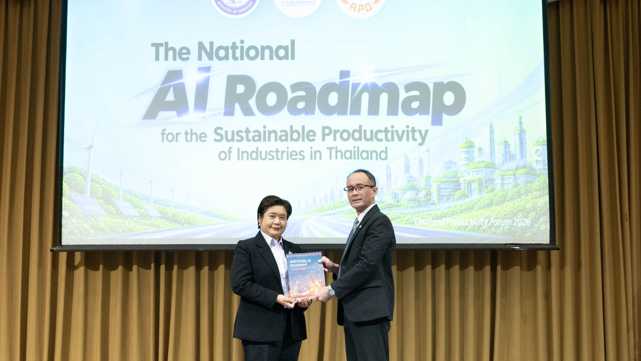
APO Secretary-General Dr. Indra Pradana Singawinata (right) hands over the National AI Roadmap for the Sustainable Productivity of Industries in Thailand to Deputy Permanent Secretary of Ministry of Industry of Thailand, Duangdow Khawjaroen.
BANGKOK, Aug. 28, 2026 (GLOBE NEWSWIRE) — Thailand today marked the official handover and dissemination of the National AI Roadmap for the Sustainable Productivity of Industries in Thailand, placing productivity rather than technology adoption itself at the center of the country’s AI transformation agenda.
The milestone took place during the Thailand Productivity Forum 2026: “Twin Transformation – AI × Productivity × Net Zero,” held in conjunction with the 1st AI Productivity Collaboration Consortium. The central message was clear: AI should be judged by the measurable value it creates for firms, workers, public services, and the wider economy.
The economic case is compelling. The APO Productivity Database 2025 reports that Thai labor-productivity growth averaged 2.1% during 2015–2023, down from 4.8% during 2010–2015, while total factor productivity averaged zero growth. As population aging constrains labor-force expansion, Thailand will increasingly need to create more value from each hour worked and each unit of capital.
“AI is not the objective. Productivity is.”
— Dr. Indra Pradana Singawinata, Secretary-General, Asian Productivity Organization
For the APO, the test is not how many AI tools are purchased, pilots launched, or people trained. It is whether AI raises output per hour, reduces downtime and defects, improves quality and asset utilization, lowers energy and material intensity, accelerates innovation, and strengthens the productive capability of workers.
Deputy Permanent Secretary of the Ministry of Industry Duangdow Khawjaroen reinforced the same productivity-first framing, linking digital transformation and green transformation through AI × Productivity × Net Zero. In her prepared remarks, she said: “Productivity represents the tangible outcomes of doing things better using fewer resources, reducing costs and waste, and creating greater value.” She also stressed that “good AI begins with good data,” highlighting the ministry’s i-Industry and i-SingleForm systems and practical applications such as predictive maintenance, energy-efficiency optimization, supply-chain analysis, real-time quality inspection, greenhouse-gas assessment, and executive decision support.
Prepared collaboratively by the Thailand Productivity Institute (FTPI) and APO with the technical support of FutureLab, the roadmap is grounded in 23 in-depth stakeholder interviews, a strategy workshop, and practical AI training. Importantly, its quantitative items are presented as recommended goals for the Ministry of Industry: a 15% productivity increase across specified MIND priority sectors by 2030; at least 60% AI adoption among large enterprises and 40% among SMEs in key sectors; at least 80 targeted AI pilot projects across priority sectors, with 30% scaled into full production; and certification of at least 50,000 industrial workers and 5,000 AI specialists by 2030.
Thailand already has a powerful proof point. In 2025, the World Economic Forum (WEF) added Midea’s Si Racha facility to its Global Lighthouse Network after the plant deployed 72 digital and AI solutions. WEF-reported outcomes included a 43% reduction in order lead time, a 32% decline in customer complaints, and a 62% improvement in employee qualification speed, evidence of what becomes possible when AI is integrated with process redesign, workforce development, and operational discipline.
The next challenge is diffusion. In the 2024 ETDA–NSTDA AI Readiness study, 580 organizations responded; 17.8% reported already using AI, while 73.3% planned future adoption. The productivity opportunity lies in moving enterprises from intention to economically valuable deployment through use-case selection, data readiness, workflow redesign, worker adoption, integration, scaling, and measurement.
Aligned with the APO Vision 2030 and Thailand’s Strategic Partnership Program, the roadmap provides a platform for moving from project-based AI adoption toward a result-oriented productivity transformation system. The next test will not be how many AI initiatives Thailand launches, but how widely AI helps enterprises, especially SMEs, to create more value, build stronger capabilities, and compete sustainably.
The defining question is no longer whether Thailand will use AI. It is how effectively Thailand can turn AI into productivity improvements that are measurable, scalable, sustainable, and broadly shared.
About the APO
The APO is a regional intergovernmental organization dedicated to improving productivity in the Asia-Pacific region through mutual cooperation. Established in 1961, the APO supports its member economies through policy advisory services, capacity building, and knowledge sharing to promote sustainable socioeconomic development.
Contact: [email protected]
Website: https://www.apo-tokyo.org
A photo accompanying this announcement is available at https://www.globenewswire.com/NewsRoom/AttachmentNg/6b413fac-4b0d-4112-8e60-68df791a3bba.

GlobeNewswire Distribution ID 9817549